



Are you eligible for a utility bill adjustment after a water leak?
A hidden plumbing leak can be stressful enough on its own. Then the utility bill arrives, and suddenly the problem feels even bigger.
The good news is that many local utility providers offer some type of leak adjustment or bill review process after a leak has been repaired. The bad news is that every town handles it differently. Some providers may adjust water charges, some may adjust wastewater charges, some only offer relief for certain types of leaks, and most require proof that the repair has already been completed.
This guide is designed to help homeowners in Raleigh, Garner, Wake Forest, Rolesville, Knightdale, Wendell, Zebulon, Cary, Apex, Holly Springs, and Fuquay-Varina understand what to do after a plumbing leak causes unusually high water usage.
Please remember that utility policies can change, and the final decision always belongs to the utility provider. Before assuming a credit will be approved, contact your utility billing office directly or review its current leak adjustment requirements.
First Step: Repair the Leak Right Away
Most utility providers will not consider an adjustment until the leak has been repaired. That means your first priority should be stopping the water loss and documenting the repair.
Depending on the leak, this may mean calling a licensed plumber, replacing failed toilet parts, repairing a broken water line, fixing a leaking water heater, or addressing a failed fixture or appliance connection.
After the repair, keep documentation. This may include:
- A licensed plumber’s invoice
- A detailed repair statement
- Receipts for parts if you completed the repair yourself
- The date the leak was found
- The date the leak was repaired
- Any photos or notes showing the location and cause of the leak
The more documentation you have, the easier it is for the utility provider to review your request.
Why the Type of Leak Matters
Not all leaks are treated the same. Utility providers often look at whether the leaked water entered the sewer system.
For example, a running toilet usually sends water down the drain and into the wastewater system. An underground service line leak, however, may allow water to soak into the ground without entering the sewer system. Because of that difference, some towns may only adjust sewer charges for certain leaks.
This is one reason it is important to explain the type and location of the leak clearly when you apply.
Raleigh Water Service Area
Raleigh Water manages utility accounts for Raleigh, Garner, Wake Forest, Rolesville, Knightdale, Wendell, and Zebulon.
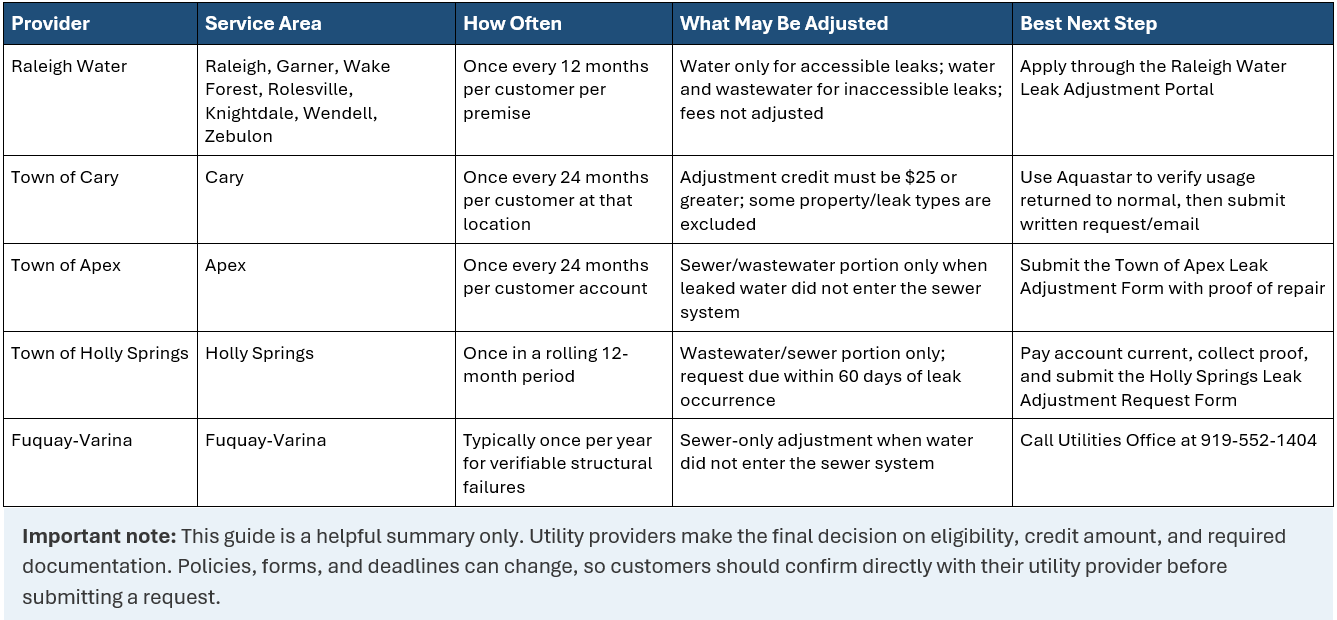
Raleigh Water generally allows one leak adjustment every 12 months per customer per premise. To qualify, the water usage during a single billing cycle must exceed the customer’s monthly average by at least two times. Adjustments may cover a maximum of two consecutive billing periods, but base fees, infrastructure fees, watershed fees, and similar fixed charges are not adjusted.
Raleigh Water separates leaks into two main categories.
Accessible leaks are leaks that can usually be seen or heard, such as toilets, faucets, hose bibs, or visible piping. For accessible leaks, Raleigh Water may adjust the water consumption charges down to double the customer’s monthly average. Wastewater charges are generally not adjusted for accessible leaks.
Non-accessible leaks are leaks that cannot easily be seen or heard, such as underground water line leaks, pipes inside walls, or similar hidden leaks. For non-accessible leaks, both water and wastewater consumption charges may be adjusted down to double the monthly average.
To apply, repair the leak, gather proof of repair, and submit the adjustment request through Raleigh Water’s leak adjustment process.
Town of Cary Service Area
Cary utility customers should follow the Town of Cary’s bill review process after a leak has been repaired. Cary encourages customers to monitor usage through the Aquastar portal, which can help verify whether usage has returned to normal after the repair.
Cary’s process may require the customer to notify the town after the repair is complete and provide the repair date and type of leak. Customers should include a plumber’s invoice or itemized receipts for parts if they completed the repair themselves.
Because Cary reviews leak adjustments through its own utility process, customers should contact Cary directly for the most current eligibility rules, timelines, and documentation requirements.
Town of Apex Service Area
Apex utility customers follow the Town of Apex leak adjustment process. Apex’s policy focuses on a credit toward a portion of the sewer or wastewater charges, rather than the full water usage itself.
This is important because Apex generally considers whether the leaked water entered the sanitary sewer system. If water leaked into the ground, such as from an exterior or underground line, the account may be eligible for a sewer-related credit. However, leaks where water goes down a household drain, such as a running toilet or dripping interior faucet, may not qualify for a sewer credit.
To apply in Apex, repair the leak immediately, collect documentation, and submit the request through the official Town of Apex Leak Adjustment Form. Property owners are responsible for repairs from the main meter box to the dwelling.
For billing timeline questions, Apex customers can contact the Apex Billing & Collections team directly.
Town of Holly Springs Service Area
Holly Springs operates its own municipal utility network and has specific rules for leak adjustments. Like Apex, Holly Springs focuses financial relief on wastewater charges rather than the full water portion of the bill.
Holly Springs generally allows one adjustment in a rolling 12-month period. Usage during the leak must exceed twice the customer’s normal monthly average, and the request must be submitted within the town’s required deadline. The town uses prior average usage to calculate what the normal sewer charges should have been and may credit back the eligible excess wastewater portion.
Holly Springs also excludes certain types of water use or leaks from adjustment consideration, including leaks between th emeter and street, issues related to some household appliances, pool maintenance, vehicle washing, and vandalism.
Before an adjustment can be approved, the utility account generally must be current. Customers should provide proof of repair, such as a licensed plumber’s bill or a retail receipt from a plumbing supply store if the repair was completed by the homeowner.
Holly Springs customers can submit the Leak Adjustment Request Form online or provide paperwork through the Finance Department at Holly Springs Town Hall.
For future prevention, Holly Springs customers can also use the WaterSmart Portal to track water usage and receive alerts for unusual or continuous water consumption.
Town of Fuquay-Varina Service Area
Fuquay-Varina handles utility billing directly through the town. Its leak adjustment process is more limited than some other municipalities because it focuses on the sewer portion of the utility bill.
Fuquay-Varina may consider a sewer adjustment when the leaked water did not enter the sewer system. Examples may include underground service line leaks, hot water tank leaks, or outside faucet leaks.
Leaks where water does go into the sewer system, such as running toilets or leaking interior sinks and faucets, are not generally adjustable.
To request a review, repair the problem, gather a detailed repair statement or receipt, and contact the Fuquay-Varina Utilities Office directly.
What Customers Should Do After a Leak
If you discover a plumbing leak and are worried about a high utility bill, take these steps:
- Shut off the water if needed to prevent further damage.
- Have the leak professionally repaired as soon as possible.
- Keep all invoices, receipts, and repair documentation.
- Note the date the leak was discovered and repaired.
- Monitor your water usage after the repair.
- Contact your utility provider quickly to ask about its current adjustment process.
- Submit the required form and documentation before the deadline.
We Can Help With the Repair Documentation
A utility adjustment is never guaranteed, but having a clear repair invoice can help support your request. When our licensed plumbing team repairs a leak, we provide documentation showing the work performed so you have the information you need when contacting your utility provider.
If you have a leaking toilet, faucet, water heater, underground water line, or other plumbing issue, don’t wait for the next utility bill to confirm there is a problem. The sooner the leak is repaired, the better chance you have of reducing water waste, limiting damage, and preparing the documentation your utility provider may request.
Contact our team to schedule plumbing leak repair or inspection in the Raleigh, Cary, Apex, Holly Springs, Fuquay-Varina, and greater Triangle area.
NCWaterHeaters.com serves homeowners in the Triangle, providing ethical services at a fair cost. Whether you need a water heater, plumbing repair, or guidance with a plumbing problem, our highly skilled plumbing team can help. Call us today at 919-868-3585