




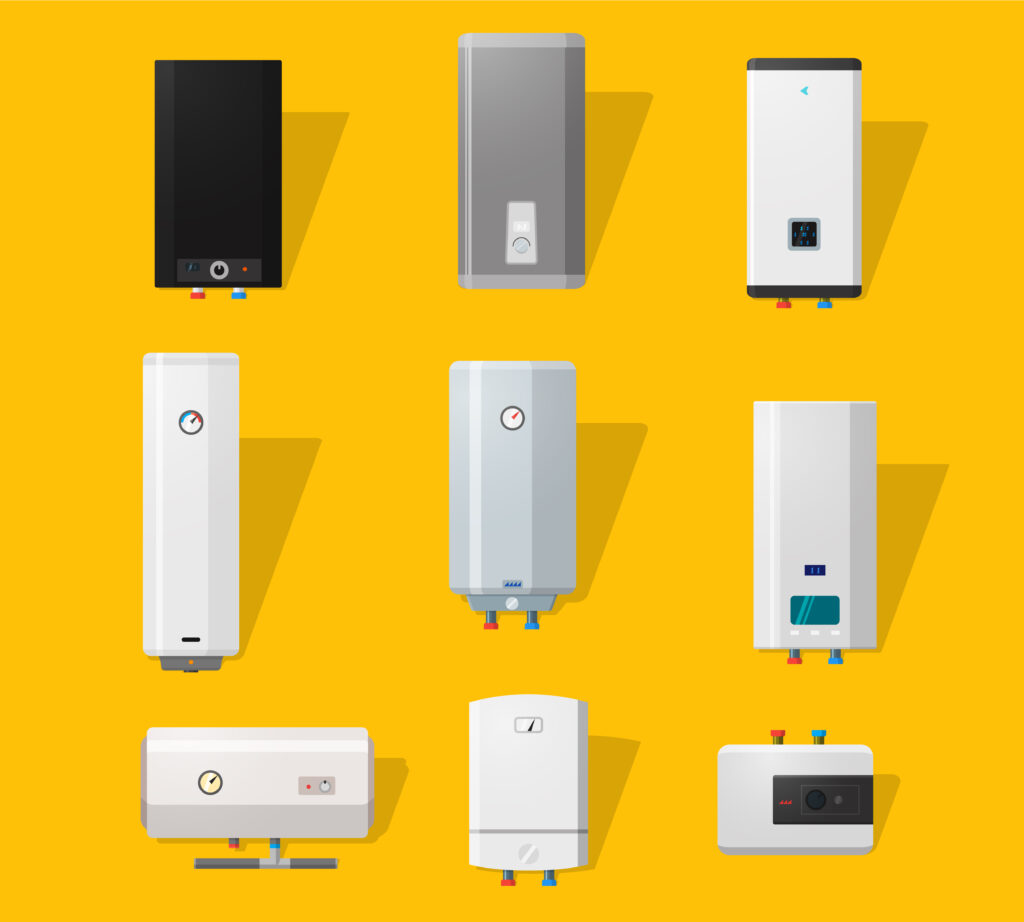
Few household appliances are as vital yet as frequently overlooked as the water heater until the hot water stops flowing. Whether you’re dealing with a sudden breakdown, noticing a drop in performance, or proactively looking to upgrade before the strict 2029 Department of Energy (DOE) efficiency mandates rewrite the industry rules, choosing the right hot water system is a significant decision. That’s why we’ve created Everything Homeowners Need to Know About Water Heaters: The Ultimate Guide.
At NCWaterHeaters.com, we believe an educated homeowner is our best customer. This comprehensive guide breaks down every aspect of modern water heating technology, from standard tanks to space-age polymer systems, specialized commercial applications, intricate venting requirements, and the critical maintenance needed to protect your investment.
1. Understanding the Different Types of Water Heaters
Every home has unique hot water demands, spatial limitations, and utility access. Choosing a water heater requires balancing upfront costs against long-term energy savings and performance.
Standard Electric Storage Tank Water Heaters
The traditional electric storage tank keeps a continuous reservoir of water heated to a set temperature (typically 120°F to 140°F) using internal electrical resistance elements.
- Advantages: Lowest initial installation and equipment cost. Straightforward mechanics make for fast, simple replacements. They require no venting system, allowing them to be tucked into small closets or tight interior spaces.
- Disadvantages: High operational cost. Because they continuously cycle on and off to maintain water temperature even when no one is home (known as standby heat loss), they consume a significant amount of electricity. They also have a finite capacity; once the tank is drained, you must wait for it to recover.
- Average Lifespan: 8 to 12 years.
Standard Gas Storage Tank Water Heaters
Gas tank units utilize a burner at the bottom of the tank fired by natural gas or propane to heat the water storage reservoir.
- Advantages: Faster recovery times than standard electric tanks, meaning they recreate hot water much quicker after heavy use. They typically cost less to operate monthly compared to standard electric resistance tanks, depending on local gas utility rates.
- Disadvantages: They require dedicated, code-compliant venting systems to exhaust combustion byproducts safely. Standby heat loss still applies, and they require a continuous fuel supply line.
- Average Lifespan: 8 to 12 years.
Hybrid (Heat Pump) Water Heaters
Hybrid water heaters are the ultimate energy-savers for all-electric homes. Instead of generating heat through resistance elements, a hybrid unit uses a small compressor mounted on top of the tank to extract heat from the surrounding air and transfer it directly into the water.
- Advantages: Incredible energy efficiency, often up to 3 to 4 times more efficient than a standard electric tank, which dramatically slashes monthly utility bills. They also pull moisture out of the air.
- Disadvantages: Higher upfront equipment cost. They require specific physical space (roughly 700 cubic feet of surrounding air) or dedicated ducting to breathe properly. They also vent cool air back into the room, which may not be ideal for tight interior closets.
- Average Lifespan: 10 to 15 years.
The Essency Water Heater
The Essency water heater represents a revolutionary leap in water heating technology by completely rethinking tank construction. Operating like a “thermal battery,” it features a commercial-grade polymer tank filled with static water used purely to store heat. When you turn on a faucet, domestic tap water rushes through an oversized internal stainless steel heat exchanger, heating instantly on demand.
- Advantages: The polymer tank will never rust or corrode, entirely eliminating the need for sacrificial anode rods and drastically reducing maintenance. It combines the massive, instantaneous delivery capacity of a storage tank with the fresh, on-demand water quality of a tankless system.
- Disadvantages: Premium upfront equipment cost compared to standard electric models.
- Average Lifespan: Up to 30 years due to its rust-proof polymer design.
Gas-Fired Tankless Water Heaters
Tankless water heaters eliminate water storage entirely. When a hot water tap is opened, a flow sensor triggers a powerful gas burner assembly that flash-heats the water as it moves through a compact copper or stainless steel heat exchanger.
- Advantages: Endless hot water on demand. Since there is no tank, you never run out of hot water, making it ideal for large families or homes with massive soaking tubs. They are highly efficient because they consume zero energy when hot water isn’t actively being used. They also free up massive amounts of square footage by mounting directly to a wall.
- Disadvantages: Higher initial installation cost, as they frequently require retrofitting gas lines to handle higher BTU loads and modifying exhaust venting configurations as well as an electrical requirement.
- Average Lifespan: 20 or more years with proper, routine maintenance.
Point-of-Use (POU) Water Heaters
Point-of-Use heaters are miniature water heaters (ranging from tankless modules to small 2-to-6-gallon tanks) installed directly at the fixture they serve. While occasionally found in residential wet bars, they are a staple of commercial applications.
- Advantages: Eliminates the “wait for hot water” by providing immediate heat right at the fixture. Perfect for commercial hand sinks, remote office restrooms, or strip mall retail spaces where routing a long hot water line from a central boiler room is structurally impractical or inefficient.
- Disadvantages: Limited capacity. A POU unit is designed to serve a specific, isolated fixture and cannot handle whole-building or multi-fixture concurrent demands.
2. A Crucial Deep Dive into Gas Venting Systems
When installing a gas-fired water heater, the venting system is literally a matter of life and death. Carbon monoxide is a colorless, odorless byproduct of gas combustion that must be completely and safely exhausted from the home. Gas water heaters utilize highly specific venting configurations that are engineered around thermodynamics and atmospheric pressure. These systems are absolutely not interchangeable.
One of the most common, and dangerous, misunderstandings in the plumbing industry involves confusing Atmospheric Vent units with Direct Vent (DV) units.
Atmospheric Vent Systems
Atmospheric venting relies on natural buoyancy. Because hot air rises, the hot exhaust gases from the burner naturally float up through a vertical metal flue pipe and exit out through the roof. This system draws its combustion oxygen directly from the air inside the room where the water heater sits.
- Application Constraints: They must have open access to ambient indoor air and a clear vertical path out of the roof structure.
Direct Vent (DV) Systems
Direct Vent systems are completely sealed environments. A DV water heater utilizes a specialized co-axial pipe (a pipe-within-a-pipe). The outer pipe pulls fresh, oxygen-rich air directly from the outside of the home into the sealed combustion chamber, while the inner pipe pushes the exhaust gases back outside. Because it does not rely on indoor room air, a DV unit can safely be installed in tightly sealed spaces, closets, garages, and more.
Power Vent Systems
Power vent heaters use an integrated electric blower motor mounted on top of the unit to mechanically push exhaust gases horizontally out through a side wall using cost-effective PVC or polypropylene piping.
The Ultimate Safety Rule: Why You Cannot Interchange Venting
CRITICAL SAFETY & LEGAL WARNING: It is strictly illegal, a severe building code violation, and incredibly dangerous to install an atmospheric vent water heater in place of a Direct Vent (DV) unit.
If a technician installs a standard atmospheric heater into a space specifically engineered for a Direct Vent system (such as a tight, unventilated closet or a confined crawl space), the burner will quickly starve the room of oxygen. This leads to incomplete combustion, creating a rapid and lethal buildup of carbon monoxide. Furthermore, without a proper vertical path for natural buoyancy, the toxic exhaust will backdraft directly into the living spaces of the home, posing a fatal threat to the occupants. In some extreme cases fire and property damage may result.
3. Specialized Hydronic & Recirculation Tech: Side Loop Systems
For homes with advanced mechanical designs, a standard water heater hookup isn’t enough. This is where Side Loop Water Heaters come into play.
A side loop configuration utilizes a specialized domestic water heater as a multi-purpose heat source. Through an integrated heat exchanger or dedicated secondary tappings, water is drawn out of the domestic tank into a separate, closed plumbing loop.
- Hydronic Radiant Heating: The side loop pumps hot water through an under-floor piping system to provide comfortable, highly efficient radiant space heating for the home.
- Advanced Recirculation Loops: Side loops are also used to keep a continuous loop of hot water moving through large homes. Instead of waiting minutes for hot water to travel from a basement tank to a third-story master bathroom, a side loop system paired with a circulation pump ensures hot water is instantly available at every single faucet, minimizing water waste.
4. Navigating Features, Capacity, and the 2029 DOE Shifts
Water heaters are no longer simple appliances; they feature vast arrays of warranties, varying diagnostic capabilities, structural sizes, and efficiency ratings.
Sizing and System Selection
When customizing a hot water system for your property, our team evaluates several complex factors:
- Storage Capacity vs. First-Hour Rating: It’s not just about how many gallons the tank holds; it’s about the First-Hour Rating (FHR)—the total amount of hot water the unit can deliver in a single hour of peak usage.
- Output & Recovery Rates: Gas units offer higher BTUs and faster recovery times, whereas standard electric units rely heavily on storage volume to bridge peak use windows.
- Warranty Options: Systems range from standard 6-year manufacturer warranties to premium 10-to-12-year or lifetime coverage options.
The Approaching 2029 DOE Energy Mandates
In May 2029, the Department of Energy’s new efficiency mandates take full effect. These strict regulations will largely phase out traditional, standard-efficiency electric storage tanks over 35 gallons, legally requiring replacements to feature ultra-efficient hybrid heat pump technology. Similarly, standard “non-condensing” gas tankless models will face bans.
Upgrading an old system after 2029 will mean navigating mandatory retrofits, changing vent structures, and handling significantly higher upfront equipment costs. Upgrading or planning your layout with our team now allows you to stay ahead of these regulatory headaches.
5. The Critical Importance of Annual Maintenance
Every single water heater manufacturer on the market, whether it is a standard tank or a top-tier tankless unit, explicitly mandates annual maintenance to preserve your equipment’s warranty coverage and maximize its operational lifespan.
What Happens Without Maintenance?
As water is heated, dissolved minerals like calcium and magnesium naturally separate and solidify, forming a dense layer of sediment at the bottom of the tank or inside the narrow water pathways of a tankless heat exchanger.
- In Tanked Systems: This sediment acts as a thick insulation blanket between the burner/heating element and the water. The unit must run longer and hotter to heat the water, severely overheating the bottom steel tank shell, causing it to fatigue, crack, and prematurely leak.
- In Tankless Systems: Mineral scale narrows the tight passages of the heat exchanger, forcing the system to work harder, throwing error codes, drastically reducing efficiency, and eventually causing a catastrophic heat exchanger burnout.
The NCWaterHeaters.com LLC Annual Maintenance Plan
To help our neighbors protect their investments, we provide a structured, comprehensive annual maintenance plan designed to keep your system operating at peak factory specifications:
- System Flushing: Thoroughly draining and flushing sediment out of storage tanks, or running an approved descaling solution through tankless heat exchangers.
- Safety Component Testing: Verifying the proper operation of the Temperature & Pressure (T&P) relief valve, internal thermistors, and safety elements.
- Pressure Optimization: Ensuring your home’s static water pressure is correctly balanced. High water pressure accelerates tank fatigue and amplifies destructive water hammer. Our strict company policy is to test and set static pressure precisely between 60 and 65 PSI during system installations and PRV replacements, calibrating expansion tanks to match that exact baseline pressure perfectly.
6. Why Trust NCWaterHeaters.com & NCPlumbingServices.com?
When you choose a team to design, install, or service your hot water or filtration infrastructure, you need true, verified expertise, not general handymen who guess at complex codes.
Unmatched Technical Credentials
We are Class III Certified with every major manufacturer and brand in the water heater industry. This elite status means our technicians receive factory-direct training and carry advanced diagnostic capabilities for the top names in hot water:
- Rheem & Ruud
- Rinnai, Navien, Noritz (The leading names in high-efficiency tankless technology)
- A.O. Smith, State Select, Bradford White
- Emax & Essency
Whether we are engineering a complex commercial multi-unit system for a restaurant hand sink or tailored building loops, or designing a residential installation customized to your unique household demands, we handle the entire project with absolute precision. We maintain an ironclad commitment to ethics and honesty, always looking out for your property’s best interest.
Comprehensive Water Solutions: Custom Filtration
In addition to hot water systems we provide custom-tailored water filtration systems. This is especially vital for our neighbors relying on private wells, where untreated groundwater containing hard minerals, iron, low pH, or bacteria can destroy a brand-new water heater in a fraction of its normal lifespan. Every filtration system we build is custom-engineered around a precise scientific analysis of your specific water chemistry.
Our Service Area
We proudly provide free estimates and comprehensive in-home consultations across the entire region, covering:
- Raleigh, Durham, and Chapel Hill (The Triangle)
- Apex, Cary, and Garner
- Fuquay-Varina, Angier, and Knightdale
- Clayton and Mooresville
Don’t wait for a cold shower or an unexpected leak to discover the condition of your home’s water system. Contact NCWaterHeaters.com LLC today to speak with a Class III certified specialist, schedule your annual maintenance, or book a free consultation for your next upgrade!